If you’ve designed a mixed-technology assembly that contains both surface mount and through-hole components, you’ll want to choose a soldering technique that ensures the strongest and most reliable solder joints. While both the Selective Solder machine and the Wave Solder machine ensure reliable solder joints, the complexity of your assembly will most likely determine which soldering technique is best for your product. They are distinctly different techniques. It’s a micro-nozzle application versus full board immersion, almost like choosing between an eyedropper and a water hose to water your house plants. Let’s look at factors to consider when comparing Selective Solder to Wave Solder.
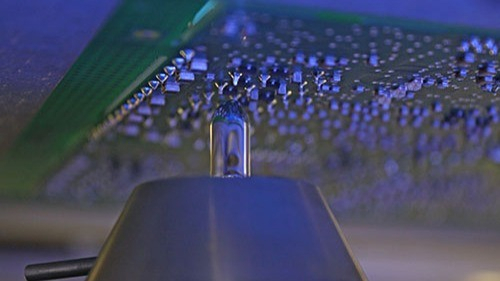
The Selective Solder machine provides a PCB assembly technique that targets specific components and areas on the board. Ideal for complex and mixed-technology boards, the machine uses a programmable nozzle to deposit precise solder amounts on specific joints. The Wave Soldering process is an inline process in which the PCB is treated with flux, is preheated, and immersed in molten solder. There are both lead-based and non-leaded Wave Solder machines available. Initially developed for boards with all through-hole parts, it can solder some SMT parts as well. As the PCB runs through the machine, it submerges the PCB bottom in a molten solder wave, which wicks up through the holes and around the pins to create solder joints.
There are several advantages to using the Selective Solder technique, all of which are driven by its precision. Because it targets specific areas on the boards, there is less thermal stress on both the board and the components. Selective Solder allows for more flexibility in terms of the types of components that can be soldered. It can solder a wide range of component shapes and sizes, which can prove difficult when using other types of soldering methods. In addition, precision solder application means there are fewer masking requirements, which leads to cost savings because there is less need for pallets or masks that protect the other areas of the boards.
Wave Solder, on the other hand, also has several advantages. Like Selective Solder, Wave Soldering provides a stronger solder joint quality. It’s a preferred method for production runs, since it can be set up quickly and solder a large number of boards in very little time. Reduced manual labor means it’s affordable and timesaving while providing high production efficiency. Overall, it’s good for bulk manufacturing.
Unlike the Wave Solder process, Selective Solder is a slower process for a couple of reasons. Its programming complexity alone slows things down. Set-up and programming is time consuming and requires careful planning to ensure accuracy. Even once the machine gets going, it remains a slower process because it requires such precision while it focuses on individual or groups of components.
While generally beneficial for many high-volume production runs, Wave Soldering is not the best option for every PCB assembly for several reasons. Firstly, it’s not an optimal method for complex mixed-technology boards, as it can miss spots and create bridges between connections. When forcing it onto incompatible assemblies, common defects such as solder balls and poor hole fill due to incorrect conveyor speed or improper fluxing can occur. Passing the board through the wave of molten solder also subjects the components to high thermal stress, potentially compromising their performance. PCBAs used in applications like Aerospace, medical, and automotive electronics often require controlled thermal profiles and minimal mechanical stress, so not always the best candidates for Wave Soldering.
In conclusion, if your assembly consists of through-hole components, both Selective and Wave Soldering methods may be appropriate. As with anything else, there are pros and cons to each. However, a good manufacturing partner will determine and implement the right process based on the assembly specifications. If your assembly is densely populated with a mixture of components, Selective Solder would be the best option. If high-volume production is necessary and your PCB has a simpler design, Wave Soldering will most likely be the chosen method. At Janco Electronics, we offer both Selective Soldering and Wave Soldering for mixed-component assemblies. You can rest assured that your assembly will be built to your specifications using the best processes, ensuring the highest quality possible.